
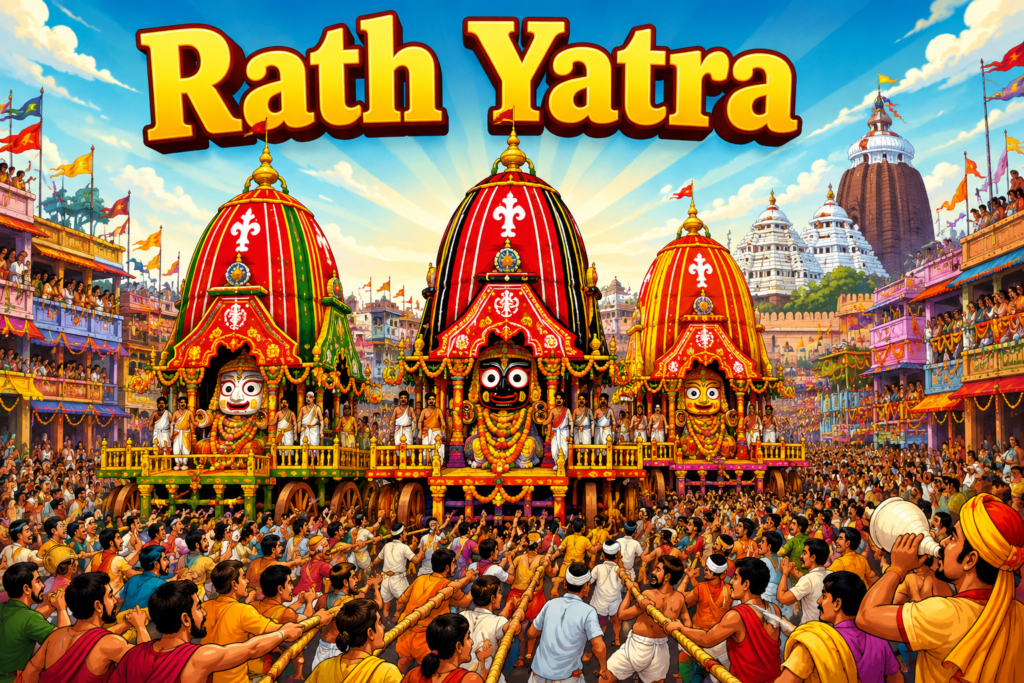

Every year, the coastal town of Puri in Odisha witnesses a remarkable transformation. Streets that usually echo with the sounds of everyday life become filled with devotional songs, temple bells, conch shells, and the chants of millions of pilgrims. The reason is Rath Yatra, a festival that is not only one of India’s most significant religious events but also an enduring symbol of faith, unity, and cultural heritage.
For devotees, Rath Yatra is much more than watching three magnificent wooden chariots move through the city’s Grand Road. It is a rare opportunity to experience a centuries-old tradition where the deities leave the sanctum of the temple and come among the people. The festival carries a powerful message—that divinity belongs to everyone, regardless of social status, caste, or background.
A Festival Unlike Any Other
Many religious celebrations invite devotees to visit temples, but Rath Yatra reverses that tradition. During the festival, Lord Jagannath, Lord Balabhadra, and Devi Subhadra leave the Jagannath Temple and travel to the Gundicha Temple in beautifully decorated wooden chariots.
This annual journey has made Rath Yatra one of the most recognised festivals in the world. It attracts pilgrims from every corner of India as well as international visitors who come to witness one of Odisha’s greatest cultural spectacles.
The procession is not merely ceremonial. For countless devotees, pulling the ropes of the chariots is considered an act of deep faith and devotion.
Where Tradition Meets History
The roots of Rath Yatra stretch back many centuries, making it one of the oldest continuously celebrated festivals in India. Historical records, temple traditions, and local customs have preserved the celebration across generations, allowing it to remain an integral part of Odisha’s identity.
Despite changing times, the essence of the festival has remained unchanged. Families continue traditions passed down through generations, while artisans, temple servitors, and local communities work together to prepare for the annual event.
This continuity has helped Rath Yatra become more than a religious celebration—it is a living tradition that connects Odisha’s past with its present.
The Three Chariots That Capture the World’s Attention
One of the defining features of Rath Yatra is the construction of three massive wooden chariots. Unlike permanent temple structures, these chariots are built anew every year following age-old rituals and traditional craftsmanship.
Each chariot belongs to one of the three deities.
Nandighosha carries Lord Jagannath and is the largest of the three with sixteen wheels.
Taladhwaja, dedicated to Lord Balabhadra, stands slightly smaller and is supported by fourteen wheels.
Darpadalana, also known as Debadalana, carries Devi Subhadra and is built with twelve wheels.
The annual rebuilding of these chariots highlights the extraordinary skills of Odisha’s traditional carpenters and artisans, whose craftsmanship has been preserved for generations.
Weeks of Preparation Before a Single Wheel Moves
Although Rath Yatra is known for its grand procession, the festival begins long before the chariots appear on the Grand Road.
Construction starts on Akshaya Tritiya, when sacred timber is transformed into the towering chariots through carefully observed rituals.
Later comes Snana Purnima, during which the deities are ceremonially bathed. Following this ritual, they remain away from public view during Anasara, a period associated with rest and recovery.
The return of the deities during Nabajouban Darshan marks an important moment for devotees before the main procession begins.
These rituals reflect the depth of temple traditions that continue to shape Rath Yatra every year.
The Day the City Comes Alive
When the day of Rath Yatra arrives, Puri awakens before sunrise.
Devotees gather along Bada Danda hours before the procession begins. Temple bells ring, devotional songs fill the air, and thousands wait patiently for the first glimpse of the deities.
The ceremonial Pahandi procession brings Lord Jagannath, Lord Balabhadra, and Devi Subhadra from the temple to their respective chariots amid rhythmic chants and traditional music.
Another defining moment follows when the Gajapati Maharaja performs Chhera Pahanra, sweeping the chariots with a golden broom.
The ritual is deeply symbolic. It reminds devotees that no individual is above another before the divine and that humility remains one of the highest virtues.
Soon after, thousands of hands grasp the massive ropes attached to the chariots. As the wheels begin to move, chants of devotion echo through Puri, creating one of the most unforgettable scenes in Indian spirituality.
More Than a Religious Celebration
Rath Yatra is also one of Odisha’s largest cultural and economic events.
Hotels welcome visitors from across the country. Local businesses experience increased demand. Traditional craftsmen, flower sellers, transport providers, food vendors, and countless small enterprises benefit from the influx of pilgrims.
For many families, the festival represents not only devotion but also an important source of livelihood.
The celebration has therefore become deeply connected with Odisha’s tourism, handicrafts, hospitality, and local economy.
A Festival That Preserves Traditional Craftsmanship
One remarkable aspect of Rath Yatra is its commitment to preserving traditional knowledge.
The techniques used to build the chariots continue to follow practices handed down through generations. Every wooden beam, wheel, and decorative element reflects the expertise of artisans whose work remains central to the festival.
In an age of modern machinery, Rath Yatra continues to demonstrate the value of skilled craftsmanship rooted in tradition.
The Journey Does Not End With the Procession
After reaching the Gundicha Temple, the deities remain there for several days before beginning their return journey during Bahuda Yatra.
The celebrations continue with Suna Besha, during which the deities are adorned with gold ornaments, drawing large numbers of devotees.
Another important ritual, Adhara Pana, is performed before the concluding ceremony known as Niladri Bije, when the deities re-enter the Jagannath Temple.
Together, these rituals form an extended festival that continues well beyond the first day of the procession.
Why Rath Yatra Continues to Inspire Millions
The enduring popularity of Rath Yatra lies in the values it represents.
It teaches that devotion is not limited by social identity. It celebrates humility over power, service over status, and unity over division.
The sight of thousands of people pulling the same chariot together serves as a powerful reminder that faith can unite communities in ways few other events can.
For many devotees, participating in Rath Yatra is not merely an annual tradition but a deeply personal spiritual experience that strengthens their connection with the divine.
Odisha’s Cultural Identity on the Global Stage
Today, Rath Yatra has become recognised far beyond India’s borders.
Images of the towering chariots, the sea of devotees, and the vibrant streets of Puri are shared across television networks, digital platforms, and social media every year.
The festival has helped introduce Odisha’s history, traditions, art, architecture, and spiritual heritage to audiences around the world.
It continues to strengthen the state’s identity as one of India’s most important cultural destinations.
A Living Tradition That Moves Forward Every Year
Unlike historical monuments that remain unchanged, Rath Yatra is a living tradition. Every year brings newly built chariots, fresh decorations, renewed devotion, and another opportunity for millions to participate in a festival that has stood the test of time.
Its enduring appeal lies not only in its rituals but also in its message. It reminds people that faith is strongest when it brings communities together, preserves traditions, and inspires compassion.
As the giant chariots roll through the streets of Puri, Rath Yatra continues to unite generations through devotion, culture, and shared heritage. It remains one of India’s most extraordinary festivals and a timeless celebration that reflects the spiritual soul of Odisha.