
Bhubaneswar, October 28, 2026: Cyclone Arnab has weakened after completing its landfall along the Andhra Pradesh–Yanam coast, but heavy rainfall and strong winds continue to pose serious weather-related risks across southern Odisha. Authorities are monitoring vulnerable districts as concerns grow over flash floods and possible disruption to normal life.
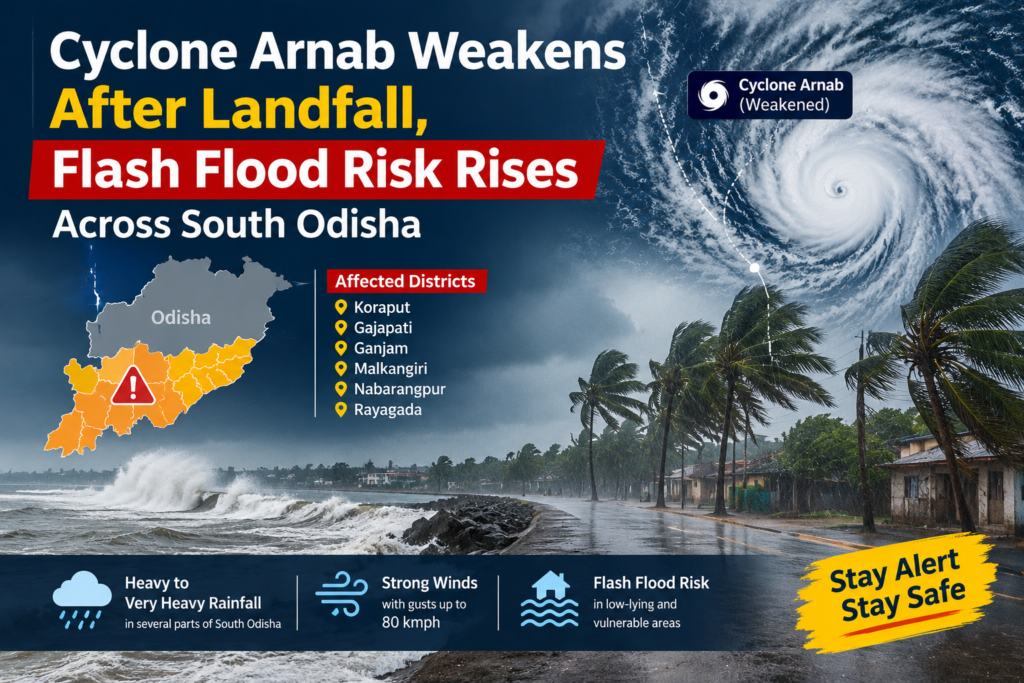
According to the India Meteorological Department (IMD), the system weakened from a very severe cyclonic storm to a severe cyclonic storm after its landfall process was completed on Wednesday morning. The cyclone is expected to lose strength gradually as it moves inland.
Heavy Rainfall Hits Several Districts
The cyclone’s influence has brought intense rainfall to several parts of southern Odisha since Tuesday. Koraput, Ganjam, Gajapati, Malkangiri and Nabarangpur are among the affected districts.
Rainfall figures reported for Wednesday morning showed that Koraput received 188 mm of rain, followed by Ganjam at 161 mm and Gajapati at 135 mm.
The sustained downpour has raised concerns about waterlogging, sudden flooding in low-lying areas and possible landslides in vulnerable locations. Residents in areas near rivers, streams and hilly terrain may face additional risks if rainfall continues.
Flash Flood Threat in Five Districts
Malkangiri, Koraput, Rayagada, Ganjam and Gajapati have been identified as districts at risk of flash flooding due to intense rainfall associated with the cyclone.
Flash floods can develop rapidly, particularly in areas with steep terrain, swollen streams and poor drainage. Residents have been advised to follow official weather bulletins and local administration instructions, and to avoid crossing flooded roads or flowing water.
Strong Winds Expected to Continue
Although Cyclone Arnab has weakened, gusty winds remain a concern across parts of southern Odisha. The IMD’s coastal bulletin warned of strong winds and heavy to extremely heavy rainfall in parts of the region.
Districts including Ganjam, Gajapati, Rayagada, Koraput, Nabarangpur and Malkangiri are among the areas likely to experience adverse weather conditions.
The combination of heavy rain and strong winds could disrupt transport, damage weak structures, uproot trees and affect electricity services. People are advised to secure loose objects, stay away from damaged power lines and limit unnecessary travel during severe weather.
Odisha Administration Monitors Situation
The state administration is coordinating with district authorities to monitor the cyclone’s impact and respond to emerging risks. Disaster management teams and local officials are focusing on vulnerable communities and areas exposed to flooding.
State Revenue and Disaster Management Minister Suresh Pujari said that no reports of major damage had been received at the time of the initial assessment, while authorities continued to monitor conditions.
The situation remains weather-dependent, and the impact may vary between districts as the system weakens and moves inland.
Residents Urged to Remain Cautious
The weakening of Cyclone Arnab does not mean that all risks have passed. Heavy rainfall can continue to trigger flooding even after a cyclone loses intensity.
Residents across southern Odisha should monitor the latest IMD forecasts and instructions issued by district administrations. People living in flood-prone and landslide-prone areas should take official evacuation advice seriously and avoid unnecessary exposure to hazardous weather.
The key concern for southern Odisha now is the continuing threat from heavy rainfall, flash floods and strong winds as Cyclone Arnab gradually weakens.