
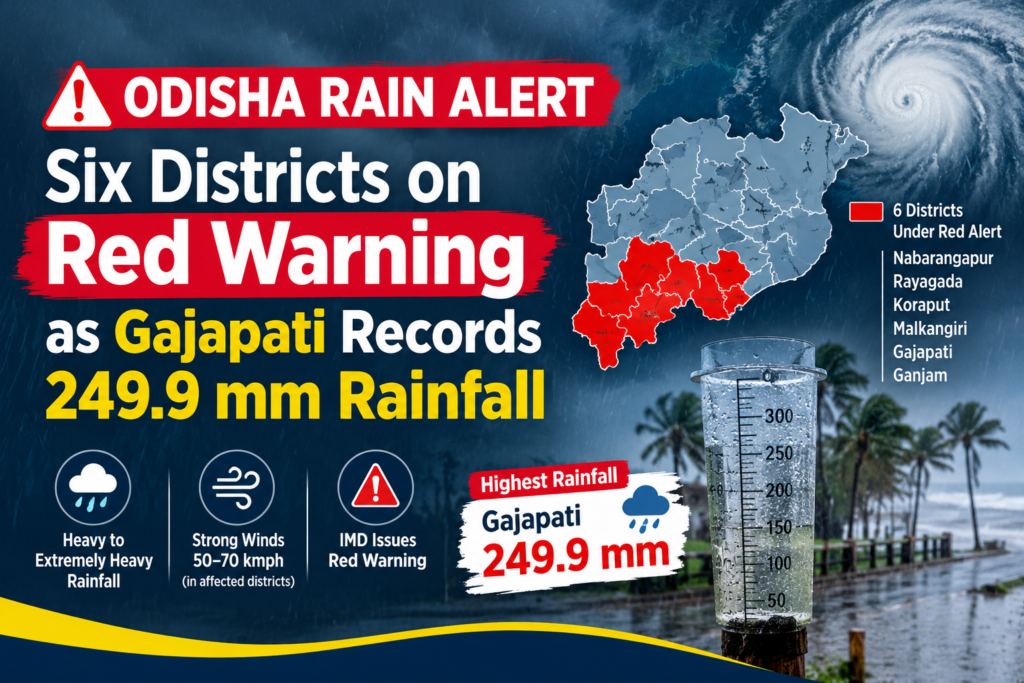

Heavy to extremely heavy rainfall has affected southern Odisha following Cyclone Arnab’s landfall in Andhra Pradesh. Gajapati recorded the highest rainfall at 249.9 mm, while the IMD warned of intense rain and strong winds across six districts.
Bhubaneswar, October 28, 2026: Several parts of Odisha experienced intense rainfall on Wednesday as Cyclone Arnab, after making landfall in Andhra Pradesh and weakening, continued to influence weather conditions across the region. The India Meteorological Department (IMD) issued a red warning for six districts, cautioning residents about the possibility of extremely heavy rain and strong winds.
According to the rainfall figures provided by the IMD, Mahendragarh in Gajapati district recorded the highest rainfall at 249.9 mm. The situation remained particularly concerning in southern Odisha, where multiple locations reported substantial precipitation.
Gajapati and Ganjam Record Intense Rainfall
Gajapati and Ganjam were among the worst-affected districts, with several monitoring stations reporting heavy downpours.
Pottangi in Koraput recorded 188 mm of rainfall, followed by Mohana in Gajapati at 168.8 mm and Ganjam station at 161.4 mm. Similiguda in Koraput received 143.1 mm, while Digapahandi in Ganjam recorded 139.5 mm.
Other locations also experienced considerable rainfall. Gumma in Gajapati received 135 mm, Berhampur recorded 131.4 mm, and Gosani reported 128 mm. Kukudahandi registered 127 mm, while Sankheimundi received 114 mm.
Rainfall was also reported in parts of Puri, Jagatsinghpur and Kandhamal, indicating that the weather system’s effects extended beyond the southern districts.
IMD Issues Red Warning for Six Odisha Districts
The IMD placed Nabarangapur, Rayagada, Koraput, Malkangiri, Gajapati and Ganjam under a red warning for extremely heavy to very heavy rainfall.
Strong winds reaching speeds of 50–70 kmph were also forecast in these districts. The warning highlighted the possibility of challenging weather conditions over the following 24 hours.
Several other districts, including Bargarh, Subarnapur, Boudh, Nuapada, Balangir, Kalahandi, Kandhamal, Puri, Khordha and Nayagarh, were placed under alerts for heavy to very heavy rainfall. Wind speeds of 40–60 kmph were forecast in these areas.
Other parts of Odisha could also experience heavy rain and winds reaching 30–50 kmph, according to the reported forecast.
Cyclone’s Movement Could Extend the Rainfall Spell
The weather system is expected to move across Odisha towards southern Chhattisgarh. Its movement could keep rainfall and strong winds active across several areas, making the coming hours important for residents and local authorities.
The impact may vary from district to district, depending on the system’s movement and local weather conditions. Residents in vulnerable locations should pay attention to official weather bulletins and local administration announcements.
Safety Advisory for Residents
With heavy rain and strong winds forecast in several districts, residents are advised to take precautions and avoid unnecessary travel during periods of intense rainfall.
People living in low-lying areas should remain alert to possible waterlogging, while those in vulnerable locations should follow any instructions issued by local authorities. Residents should also avoid flooded roads and stay away from damaged trees, loose electrical wires and other potential hazards.
The latest IMD bulletins and official district-level advisories should be followed for updated information about rainfall warnings and local safety measures.
Conclusion
Cyclone Arnab’s influence has brought intense rainfall to several parts of Odisha, with Gajapati recording 249.9 mm at Mahendragarh. With six districts under a red warning and strong winds expected in affected areas, residents are urged to remain cautious and follow official instructions as the weather system moves towards southern Chhattisgarh.