
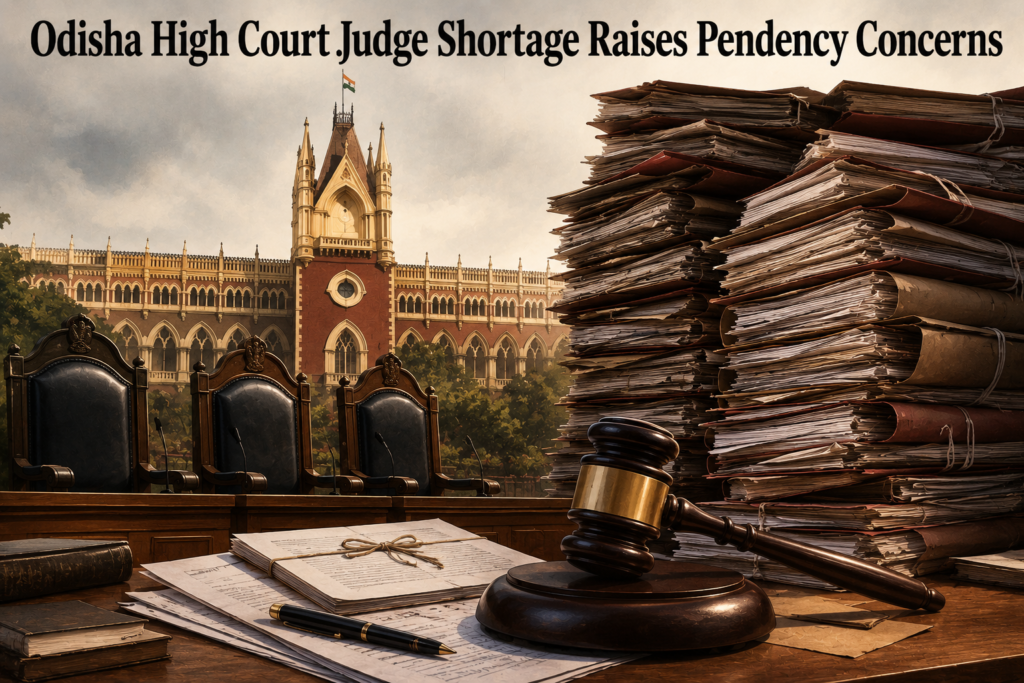

The Odisha High Court case pendency situation has come under renewed scrutiny amid concerns over the limited number of judges available to handle the court’s workload. According to the information provided for this report, around 1.72 lakh cases are pending, while only 17 judges are currently available against a sanctioned strength of 33.
The gap has prompted concern among members of the legal fraternity, with the Odisha High Court Bar Association calling for urgent steps to fill vacant judicial posts. The association has stressed that strengthening the court’s working capacity is essential for reducing the backlog and ensuring that cases are heard without avoidable delays.
The present working strength of 17 judges against 33 sanctioned posts means that nearly half of the sanctioned positions are vacant. A recent legal report also noted that the retirement of Justice Dixit Krishna Shripad brought the working strength of the Orissa High Court down to 17.
Vacant Judge Posts Add Pressure to Odisha Judiciary
The shortage of judges is significant because the High Court deals with a wide range of civil, criminal, constitutional and other legal matters. When fewer judges are available, the court’s ability to list, hear and dispose of cases can come under additional pressure.
The High Court itself maintains a dedicated case-pendency reporting system, with daily and archived reports available on its official website. Reports are published by date, allowing the status of pending cases to be monitored over time.
The issue is not entirely new. The sanctioned strength of the High Court was increased from 27 to 33 in February 2022. The High Court’s 2022 annual report said the increase was linked in part to the transfer of 49,817 cases following the abolition of the Odisha Administrative Tribunal, although only around 8,245 of those transferred cases remained on the High Court’s docket by the end of that year.
Bar Association Seeks Immediate Action
The Odisha High Court Bar Association has raised concerns over the continuing vacancies and their potential impact on the delivery of justice. Its demand is centred on filling vacant judicial positions so that the court can function closer to its sanctioned capacity.
The concern is particularly important for litigants who may already have been waiting for their matters to reach final hearing. A large backlog can affect not only the speed at which new cases are taken up but also the time required to dispose of older matters.
The figures also highlight the difference between a court’s sanctioned strength and its actual working strength. While the sanctioned strength represents the number of judges approved for the institution, the working strength reflects the judges actually available to hear cases.
Why Judge Strength Matters
Judicial vacancies are not simply an administrative issue. They can directly affect the functioning of courts and the experience of litigants, lawyers and other stakeholders who depend on timely hearings.
A 2025 report on justice delivery in Odisha had already highlighted a substantial vacancy rate among Orissa High Court judge posts, placing the vacancy level at 45.5 per cent at the time of that assessment. The report also pointed to broader capacity gaps across Odisha’s justice system.
At the same time, the High Court continues to publish case-pendency data and undertake administrative and recruitment-related measures. Its website currently lists case-pendency reports as well as recruitment and other institutional notices.
The Larger Challenge for Timely Justice
The concern over Odisha High Court case pendency ultimately goes beyond a numerical comparison between judges and vacancies. The larger issue is whether the available judicial strength is sufficient to deal with the volume and complexity of litigation before the court.
For litigants, every additional delay can mean more time spent pursuing a case. For the justice system, a sustained backlog can increase pressure on judges, lawyers and court administration.
Filling vacant judicial posts therefore remains an important part of addressing the capacity challenge. Along with appointments, effective case management and continued monitoring of pendency can help strengthen the court’s ability to deal with its workload.
The immediate demand from the Odisha High Court Bar Association reflects the urgency felt within the legal community. With 17 judges working against a sanctioned strength of 33, Odisha High Court case pendency remains an issue that requires sustained institutional attention to improve access to timely justice.
Editorial Note on the Case-Pendency Figure
The approximately 1.72 lakh pending-case figure supplied for this report has not been treated as a newly verified July/August 2026 total because the official High Court source available online publishes dated pendency reports rather than providing that figure in the accessible page text. Historical reporting also recorded 1.72 lakh pending cases at the Orissa High Court in December 2017, so the figure should not be presented as a current total without confirmation from the relevant dated official report.