
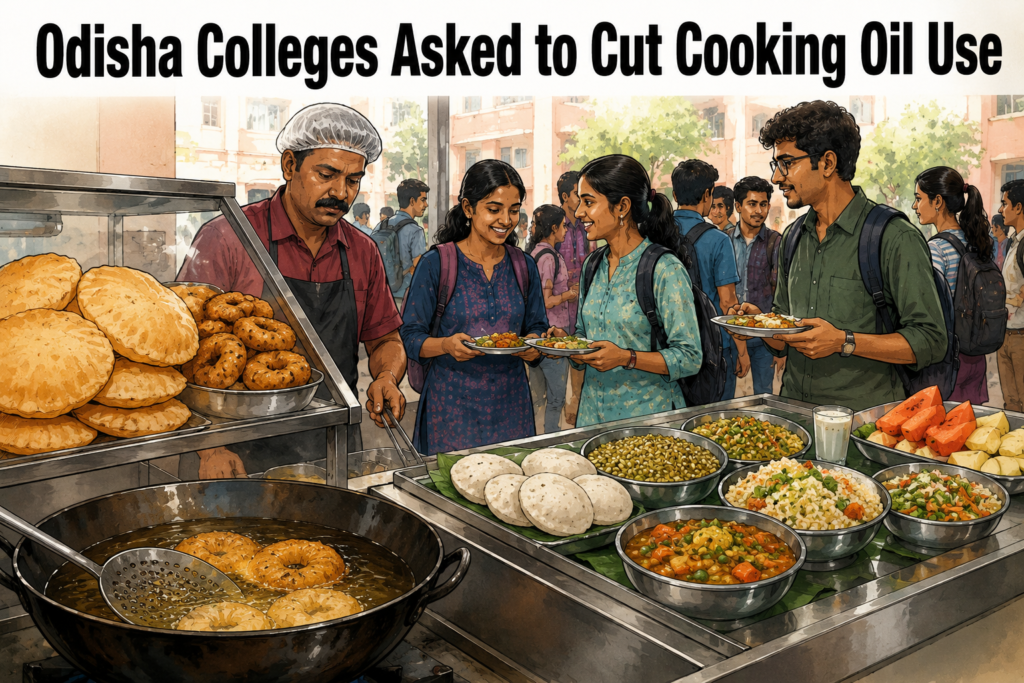

Bhubaneswar: College canteen menus in Odisha could see changes after the Higher Education Department advised government and government-aided colleges to reduce the use of cooking oil in hostels and canteens.
The department has asked college authorities to limit foods that require large quantities of oil, including items such as puri, bara and other deep-fried breakfast foods. The advisory is aimed at reducing oil consumption while ensuring that students continue to receive nutritious meals.
Odisha college canteens advised to reduce oily foods
The direction was communicated to principals of government and government-aided colleges through a letter from Higher Education Department Deputy Secretary Ramesh Chandra Behera.
According to reports on the department’s communication, college authorities have been asked to issue necessary instructions to hostel and canteen operators to reduce cooking oil consumption while preparing food for students.
The advisory specifically calls for avoiding or reducing high-oil breakfast items such as puris, vadas and other deep-fried foods. The department has also stressed that reducing oil use should not come at the expense of nutritional quality.
This means students may see changes in some regular breakfast offerings, although the available information describes the move as an advisory to reduce oil consumption rather than confirming that every college will completely remove these foods from its menu.
Why has the Higher Education Department issued the advisory?
The department linked the initiative to wider concerns over supply disruptions and the economic effects of prolonged global crises.
The letter reportedly referred to repeated disruptions to global supply chains since the COVID-19 pandemic and the impact of recent conflicts involving Ukraine and Iran on supplies of food, fertiliser and fuel.
The department also referred to an appeal by Prime Minister Narendra Modi encouraging citizens to contribute through small measures toward addressing the challenges facing the country. The reduction of cooking oil consumption in college kitchens has been presented as part of this broader effort.
Focus on lower-oil and traditional cooking options
Along with reducing deep-fried foods, the advisory encourages greater consideration of traditional cooking oils such as mustard oil and groundnut oil, as well as traditional ghee, instead of imported palm, sunflower and soybean oils.
The emphasis is therefore not simply on changing a breakfast menu. College administrations have been asked to look at how food is prepared and find ways to reduce overall cooking oil consumption while maintaining adequate nutrition.
For students living in hostels, the change could have a more noticeable effect because hostel kitchens regularly prepare meals for larger groups.
NSS and Youth Red Cross volunteers to spread awareness
The initiative is also expected to extend beyond college kitchens.
According to the reported directive, National Service Scheme (NSS) and Youth Red Cross (YRC) volunteers have been asked to organise awareness programmes in communities to encourage people to reduce oil consumption in their everyday cooking.
This gives the initiative a wider awareness component, with students potentially helping communicate the message about reducing cooking oil use beyond their campuses.
What students can expect
The immediate impact on students is likely to depend on how individual colleges implement the advisory. Some institutions may revise breakfast menus, reduce the frequency of deep-fried items or introduce alternatives requiring less oil.
The department’s instruction does not indicate that all oily foods must disappear from every college canteen. Instead, the central focus is on reducing cooking oil consumption and limiting foods that require excessive oil.
As colleges begin implementing the directions, the composition of canteen and hostel menus may gradually change.
For Odisha college canteens, the latest advisory marks a push toward lower-oil food preparation and reduced dependence on deep-fried breakfast items such as puri, bara and vada.