
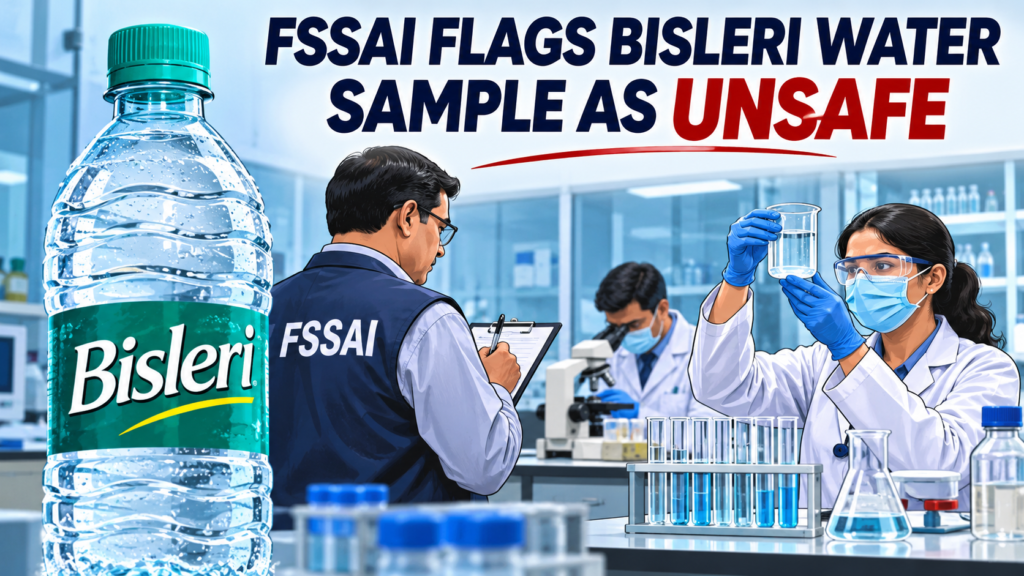

New Delhi, November 23, 2026: Concerns over Bisleri water safety have emerged after the Food Safety and Standards Authority of India (FSSAI) declared a regulatory sample of the company’s packaged drinking water unsafe following laboratory examinations. The regulator has sanctioned prosecution against Bisleri International Pvt. Ltd. under the Food Safety and Standards Act, 2006.
According to FSSAI, the initial laboratory examination found that the water sample did not comply with the prescribed limits for bromate, a chemical compound that is regulated in packaged drinking water. Following an appeal by the company, the sample was referred to a referral food laboratory for further examination.
The second laboratory also declared the sample unsafe after detecting polycyclic aromatic hydrocarbons (PAHs), raising additional concerns about the product’s compliance with food safety standards.
What Did FSSAI Find in the Bisleri Water Sample?
The initial testing identified bromate levels exceeding the permissible limit. Under India’s packaged drinking water standards, the maximum permitted bromate concentration is 0.01 milligrams per litre (10 micrograms per litre).
The presence of PAHs was subsequently reported by the referral laboratory. India’s packaged drinking water standards require polynuclear aromatic hydrocarbons to be absent or not detectable.
These findings led the regulator to classify the sample as unsafe under the Food Safety and Standards Act, 2006. FSSAI has consequently approved the initiation of prosecution proceedings against the company.
Bisleri Responds to the FSSAI Findings
Following the regulatory action, Bisleri International issued a statement on November 23, disputing aspects of the laboratory findings and maintaining that its packaged drinking water is safe for consumption.
The company said the matter relates to a batch manufactured in September 2025 at its Goa facility. According to Bisleri, FSSAI collected six samples from the facility on September 30, 2025. Initial testing found that five samples complied with the applicable standards, while the sixth recorded bromate levels of 12 micrograms per litre, compared with the prescribed limit of 10 micrograms per litre.
Bisleri said it appealed against the initial findings on November 22, 2025. The sample was subsequently sent to a referral laboratory, which reportedly found bromate within the prescribed limit but separately detected PAHs.
The company also said it arranged independent testing of the same sample at an FSSAI-approved laboratory, where bromate levels were again found to be within the permissible limit.
Questions Raised Over the Safety Findings
The development has drawn attention to the importance of regular quality checks in India’s packaged drinking water industry. Bromate is a chemical compound that can form during certain water treatment processes, particularly when ozone is used for disinfection.
PAHs are a group of chemical compounds that can enter the environment through processes such as incomplete combustion. Some PAHs are associated with serious health risks, including cancer. Their detection in a drinking water sample is therefore a significant food safety concern.
However, the regulatory findings relate to a particular sample and should not automatically be interpreted as evidence that every Bisleri bottle currently available in the market is contaminated. The findings also represent regulatory action, not a final judicial conviction against the company.
What Happens Next?
FSSAI’s decision to sanction prosecution marks an important development in the case. The proceedings will allow the regulatory authorities to pursue the matter under the provisions of the Food Safety and Standards Act, 2006.
Bisleri has maintained that its water is safe and said it will cooperate with the regulator through the appropriate process. The company has also highlighted its quality-control procedures, stating that it conducts more than 90 quality tests as part of its 10-step manufacturing process.
The case has brought renewed attention to Bisleri water safety and the need for transparency in food safety testing. Consumers will be watching for further clarification from the regulator and the company as the proceedings move forward.