
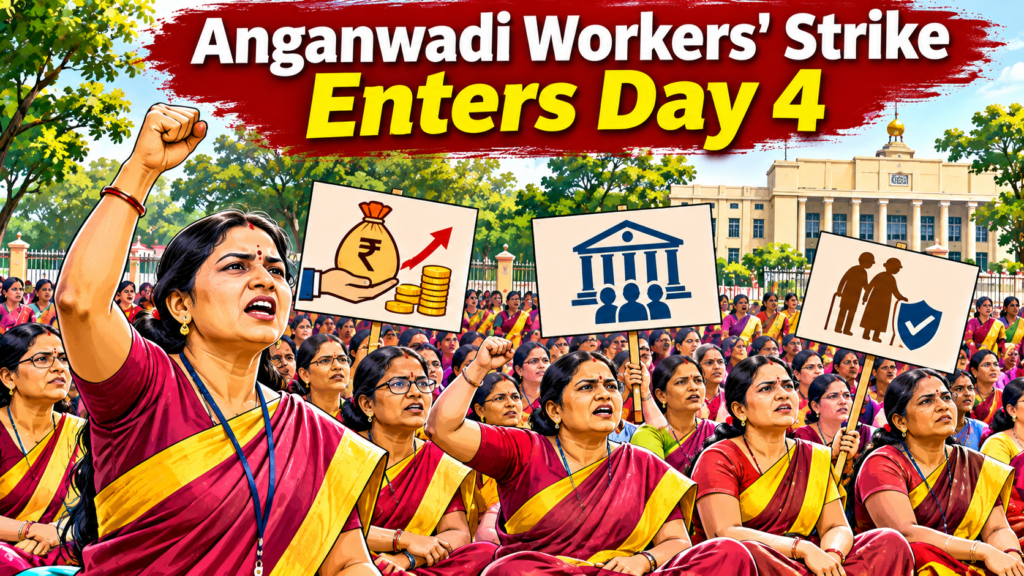

The Odisha Anganwadi workers’ strike entered its fourth day on Thursday, November 26, as hundreds of workers continued their indefinite protest at Lower PMG in Bhubaneswar. The protesters are demanding government employee status, higher monthly salaries and retirement benefits, including gratuity and pension.
The strike began on November 23, with Anganwadi workers and helpers refusing to resume their duties until their demands are addressed. Protesters have made it clear that they will not leave Gandhi Marg without written assurances from the government.
Anganwadi Workers Demand Government Employee Status
Hundreds of Anganwadi workers gathered at Lower PMG to press for their long-pending demands. One of their major demands is recognition as government employees, along with an increase in monthly remuneration.
The workers are demanding a monthly salary of Rs 30,000 for Anganwadi workers and Rs 15,000 for Anganwadi helpers. They have also sought gratuity, pension facilities and financial assistance after retirement.
According to the protesters, these benefits are necessary to provide financial security to workers who play an important role in delivering services at the grassroots level.
Workers From More Districts Join the Protest
The demonstration has been drawing participation from different parts of Odisha. Workers from Koraput, Rayagada and Nabarangpur had earlier joined the protest.
On Thursday, workers from Puri and Nayagarh districts also joined the demonstration, adding to the growing participation at Lower PMG.
A distinctive moment during the protest was the performance of traditional Manabasa rituals on the streets. The sound of traditional ululation (Hulahuli) echoed across Gandhi Marg as the protesting women continued their demonstration.
Over 75,000 Anganwadi Centres Reportedly Affected
The ongoing strike has affected the functioning of Anganwadi centres across Odisha. According to the information shared during the protest, more than 75,000 centres across the state have remained locked due to the workers’ indefinite work stoppage.
The disruption has raised concerns among parents, particularly those who depend on Anganwadi centres for early childhood education and nutritional support.
In several areas, children have reportedly been arriving at their centres only to find the doors locked, forcing them to return home without receiving the usual services.
Parents Worried as Children Miss Essential Services
The impact of the strike has also been reported in Gajapati district’s Mohana block. The Merapalli Anganwadi Centre is among the locations where the closure has affected children and their families.
Similar situations have been observed in several Anganwadi centres in Khallikote, where children have reportedly returned home after finding some centres closed. However, reports also indicate that certain centres in the area continue to remain operational.
The situation highlights the difficulties faced by families who depend on these centres for children’s nutrition and early learning activities.
Protest to Continue Until Written Assurance
Despite the growing impact of the strike, the protesting Anganwadi workers remain firm on their demands. They have announced that their indefinite agitation will continue until they receive written assurances addressing their concerns.
The fourth day of the Odisha Anganwadi workers’ strike has brought renewed attention to their demands for better remuneration, government employee recognition and post-retirement security. Meanwhile, the closure of several centres has left parents concerned about the disruption of essential services for young children.
The next developments will depend on whether the government holds discussions with the protesters and takes steps towards addressing their demands.