
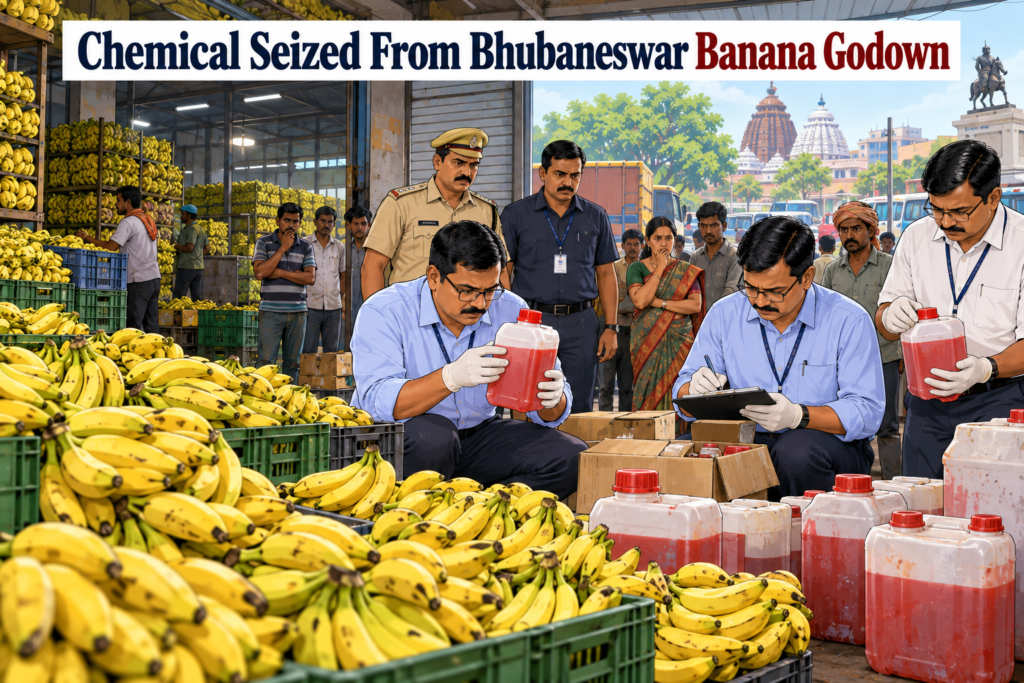

Bhubaneswar banana godown has come under attention after a large quantity of red-coloured chemical was reportedly seized from a banana storage facility near Rajmahal Square in the Odisha capital. The development has raised concerns about the way bananas reaching consumers are being handled and treated.
The reported seizure comes at a time when food safety has already become a matter of concern following questions surrounding chemically treated food products. Bananas have now emerged as the latest fruit drawing attention over the use of chemicals during handling or ripening.
Red-Coloured Chemical Found at Banana Godown
According to the information available, a large quantity of red-coloured chemical was found at a banana godown located near Rajmahal Square in Bhubaneswar.
The material was reportedly seized from the premises, bringing attention to the practices followed in the storage and preparation of bananas before they are supplied to consumers.
However, the exact identity and composition of the seized chemical have not been established in the information available for this report. Therefore, it would be premature to describe the substance as a particular chemical or determine its health impact without an official test report.
Food Safety Concerns Grow
Bananas are widely consumed across households, making concerns over their treatment particularly significant. The reported incident has raised questions about whether consumers are aware of the methods used to prepare fruits for sale.
The issue is not simply about the appearance of the fruit. Any chemical used during fruit handling needs to be assessed through appropriate food-safety procedures to determine whether its use is permitted and whether the quantity or method of application complies with applicable standards.
The reported seizure therefore puts the spotlight on the need for proper checking of fruits before they reach markets and consumers.
Questions Over Chemically Treated Bananas
The development near Rajmahal Square has also renewed concerns about chemically treated bananas being sold in the market.
At this stage, the available information does not establish how the chemical was being used, who supplied it, or whether the bananas stored at the location were treated with the seized substance. Those questions would require confirmation from the authorities and laboratory examination of the material.
For consumers, the incident is nevertheless a reminder that food safety depends not only on the final appearance of a product but also on how it is stored, processed and prepared for sale.
What Happens Next?
The reported seizure of chemical material from the Bhubaneswar banana godown is likely to draw further attention to food-safety checks in the city’s fruit supply chain.
Further clarity will depend on official findings regarding the seized substance and the circumstances in which it was found at the godown. Until those findings are available, claims about the specific chemical or its effects should be treated with caution.
The incident has already raised an important question for consumers: what substances are being used to prepare fruits for the market, and are those practices being properly monitored? The Bhubaneswar banana godown case could therefore become an important food-safety issue if further investigation confirms the use of unauthorised substances.