
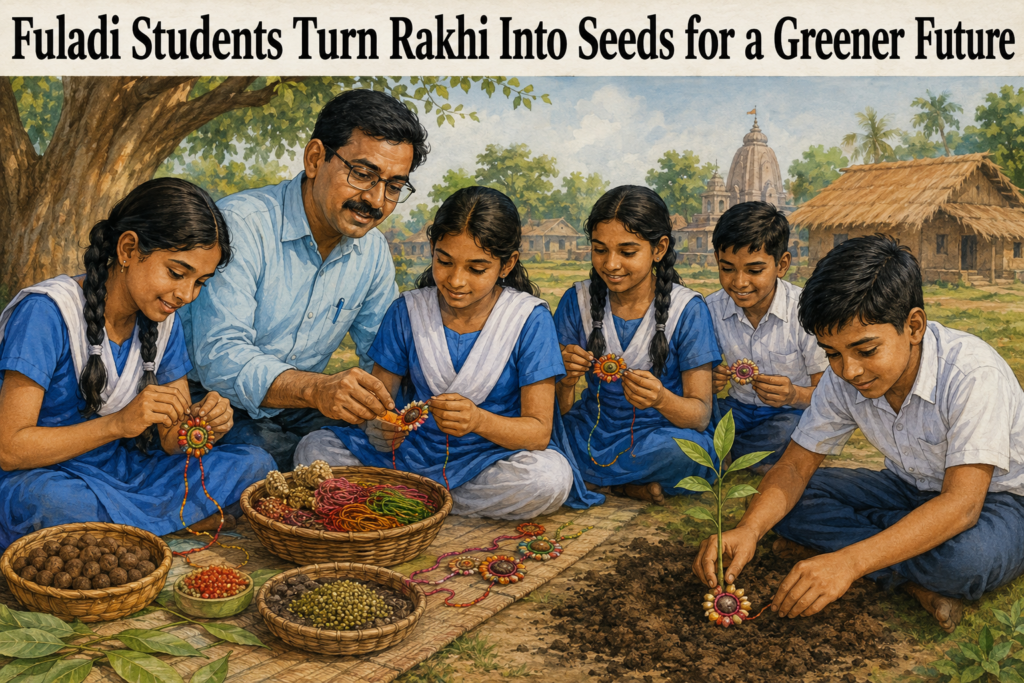

BALASORE: A creative initiative from Fuladi in Balasore is giving the traditional Rakhi a new environmental purpose. Teacher Radha Gobinda and his students are making special Seed Rakhis, combining the emotional significance of Raksha Bandhan with a message of environmental protection.
The idea is simple but meaningful: instead of treating a Rakhi as something that is used once and then discarded, the special Rakhi can be planted after it is no longer needed. The seeds incorporated into the Rakhi are intended to give it a second life in the form of a growing plant.
The initiative brings together two familiar ideas — the bond represented by Raksha Bandhan and the need to care for nature. Through their work, the students are learning that an everyday celebration can also become an opportunity to encourage environmentally responsible habits.
From a Rakhi to a growing plant
The concept behind a Seed Rakhi changes what happens after the festival. Once the Rakhi has served its traditional purpose, it does not simply have to become waste. Instead, it can be placed in soil with the hope that the seed will eventually develop into a plant.
Plantable and seed-based rakhis are also being promoted elsewhere as an alternative to conventional rakhis made with materials that may be difficult to dispose of responsibly. Such rakhis generally use biodegradable materials and incorporate seeds that can be sown after the celebration.
For the students involved in Fuladi, however, the initiative is not simply about creating a different kind of festival product. It is also an educational exercise that connects classroom learning with environmental awareness.
Students learn environmental responsibility through creativity
The involvement of teacher Radha Gobinda and his students gives the Fuladi initiative a distinctly community-oriented character. By making the rakhis themselves, students can understand the relationship between traditional celebrations, waste and the natural environment in a practical way.
The idea also gives children an opportunity to communicate an environmental message through something familiar. A Rakhi, traditionally associated with affection and protection between siblings, can carry another message — protecting and nurturing nature.
The broader concept of plantable rakhis has been used in different parts of India for several years. Seed Rakhis have been described as rakhis made with biodegradable materials and seeds that can be planted after Raksha Bandhan.
A small idea with a wider environmental message
The Fuladi initiative stands out because it uses a cultural tradition to introduce an environmental thought in a simple form. Rather than separating festivals from sustainability, the students are exploring how celebrations can be designed with nature in mind.
For families, the concept can also make the post-festival ritual more meaningful. A Rakhi that eventually becomes part of a plant creates a physical reminder of the bond celebrated during Raksha Bandhan while encouraging care for the environment.
The initiative therefore carries a message that extends beyond the Rakhi itself. It shows how students, teachers and local communities can use creativity to turn familiar traditions into opportunities for environmental awareness.
The Seed Rakhi initiative in Balasore from Fuladi offers a distinctive example of this approach. By giving an old festival tradition a plantable purpose, teacher Radha Gobinda and his students are showing how a small idea can connect celebration, learning and environmental protection.