
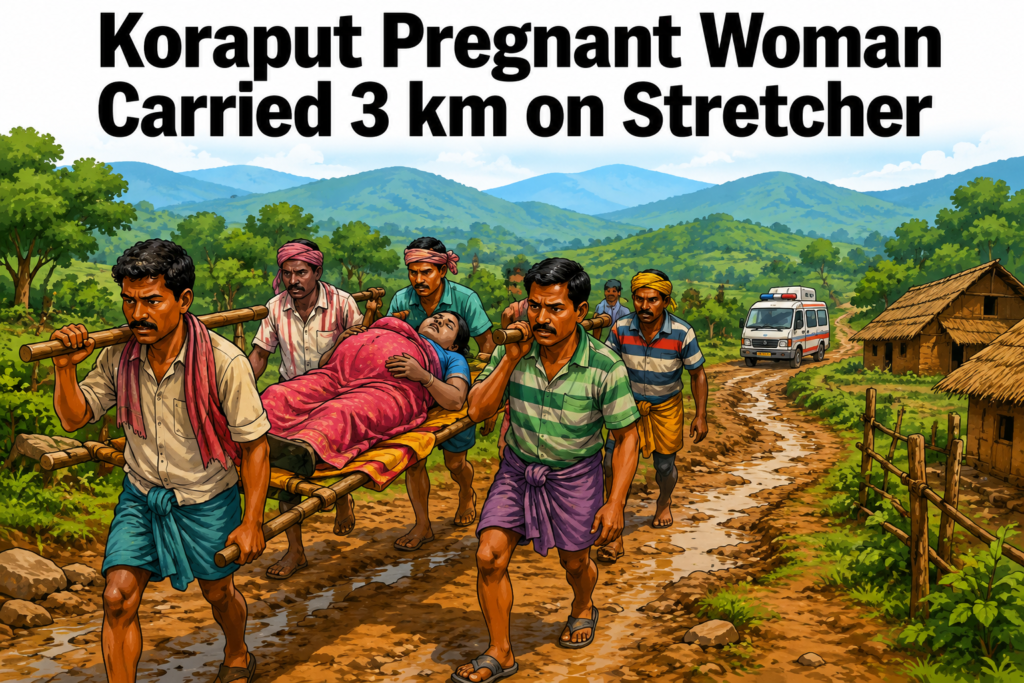

A pregnant woman from Srigamput village under Atanda Panchayat in Nandapur block of Koraput district had to be carried nearly 3 kilometres on a stretcher after an ambulance was unable to reach her village because of poor road connectivity.
The incident came to light after Mani Khillo, who was reportedly experiencing labour pain, required urgent medical assistance. According to the information available, her family contacted an ambulance for transportation to a healthcare facility.
Ambulance Could Not Reach the Village
Although an ambulance was called, it could not enter Srigamput village due to the absence of a motorable road leading to the settlement. With no direct vehicle access available, family members and local residents carried the expectant mother on a stretcher along a rural pathway for nearly three kilometres to reach a point where the ambulance could receive her.
The incident has once again highlighted the transportation challenges faced by residents in remote parts of Koraput district, where road connectivity remains a significant concern for accessing emergency healthcare.
Rural Connectivity Concerns Return to the Spotlight
For families living in isolated villages, timely medical transport can become difficult when roads are inaccessible for emergency vehicles. In cases involving pregnant women, delayed access to healthcare facilities can create additional challenges for families seeking urgent medical care.
The incident from Nandapur block has drawn attention to the importance of all-weather road connectivity in rural areas, particularly for emergency health services such as ambulance access.
A Reminder of Infrastructure Challenges
The incident involving Mani Khillo has renewed focus on the need for improved road infrastructure in remote villages of Koraput district. Ensuring that ambulances can reach every habitation remains an important aspect of strengthening emergency healthcare access in rural Odisha.
As the incident gains public attention, it underscores how essential road connectivity can be during medical emergencies, especially for pregnant women requiring immediate transportation to healthcare facilities.