
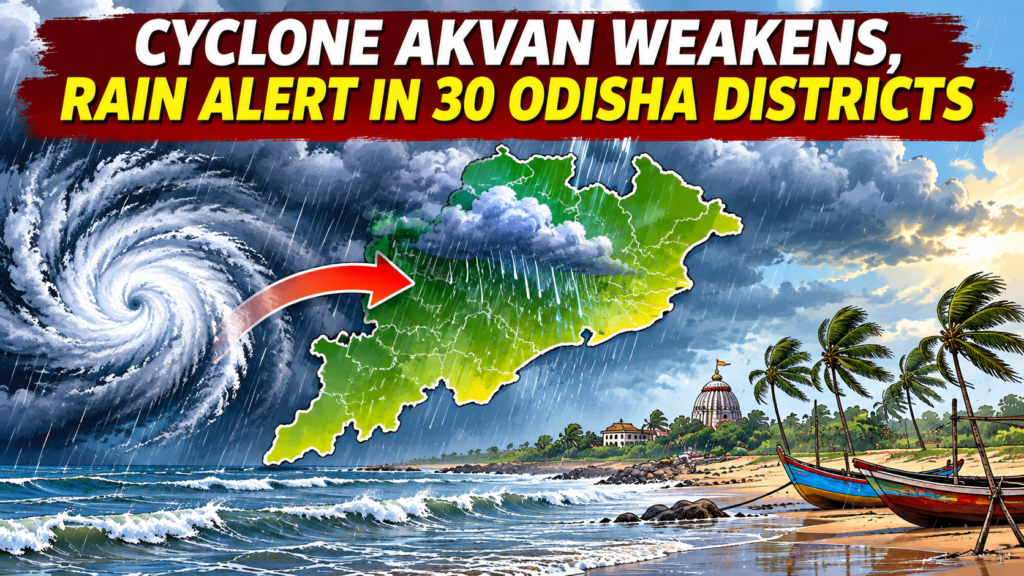

Cyclone Akvan, which crossed the north Andhra Pradesh and south Odisha coasts as a severe cyclonic storm, has weakened considerably while moving northwards over Odisha. The India Meteorological Department (IMD) reported that the system had weakened into a low-pressure area over north interior Odisha by the morning of November 21, 2026.
According to the IMD’s latest coastal weather bulletin issued at 10 AM on Saturday, the remnant weather system continued its northward movement after weakening from a depression into a well-marked low-pressure area. Its associated cyclonic circulation extended up to 4.5 km above mean sea level.
Orange Alert for 7 Odisha Districts, Yellow Alert for 23
Despite the weakening of Cyclone Akvan, rainfall activity is expected to continue in several parts of Odisha. A district-wise weather warning has placed seven districts under an orange alert, while the remaining 23 districts are under a yellow alert for November 21.
The alerts indicate that people should remain cautious about rainfall-related disruptions, particularly in areas likely to receive heavy rainfall.
Several districts, including Balasore, Mayurbhanj, Keonjhar, Kendrapara, Bhadrak, Jagatsinghpur and Jajpur, are among the areas expected to experience rainfall. Puri, Khordha and Cuttack may also receive rain.
Rainfall Intensity Expected to Decrease
With the weather system losing strength, rainfall activity across Odisha is expected to gradually reduce. The IMD has indicated that light to moderate rainfall may continue in different parts of the state, even as the possibility of widespread heavy rainfall decreases.
The northward movement of the system may also influence weather conditions in neighbouring regions, including Chhattisgarh, West Bengal, Jharkhand and Bihar.
Night Temperatures May Drop from November 22
The weakening of the cyclone and the expected improvement in cloud conditions may also affect night temperatures across Odisha.
According to the weather forecast reported by Odisha Television, minimum temperatures are likely to decrease by around 2 to 4 degrees Celsius from November 22 onwards.
Residents should continue to follow official weather advisories, particularly in districts under rainfall warnings. Local authorities and people in vulnerable areas should remain alert to possible waterlogging and weather-related disruptions.
Although Cyclone Akvan has weakened into a low-pressure area, its impact on Odisha’s weather is not yet completely over. The Cyclone Akvan weather system is expected to move further northwards, with rainfall activity gradually easing across the state.