
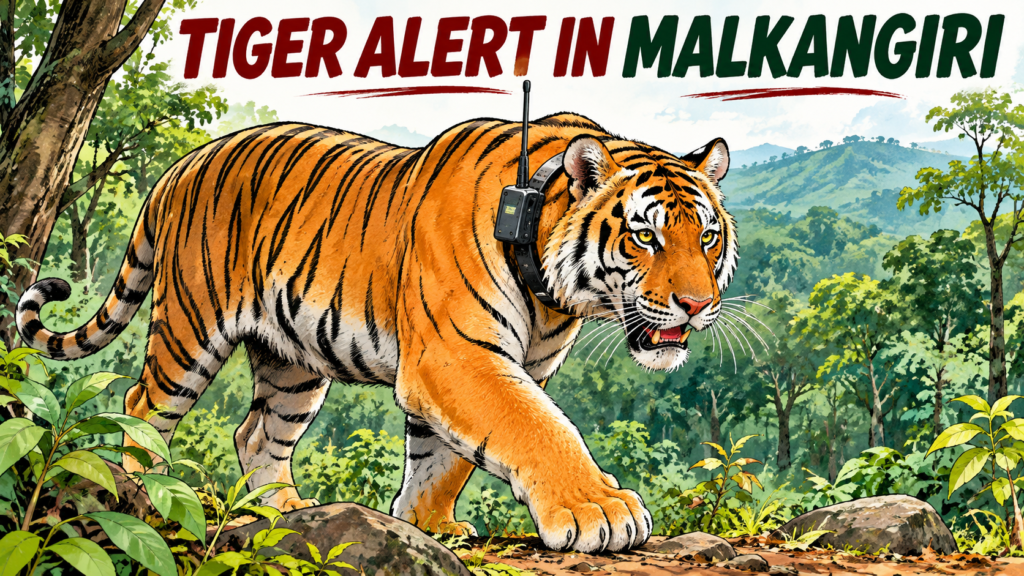

A tiger in Malkangiri has prompted the Odisha Forest Department to step up surveillance after a radio-collared big cat from neighbouring Andhra Pradesh entered the Motu forest range. Forest officials have alerted nearby villagers and deployed Rapid Response Teams (RRTs) to monitor the animal’s movement and prevent any possible human-wildlife conflict.
According to forest officials, information about the tiger’s presence in Odisha was received through tracking signals from its radio collar. The animal reportedly moved into Malkangiri from the Papikonda landscape in Andhra Pradesh.
The development has led to increased vigilance in villages located near the inter-state border, with forest personnel closely monitoring the situation.
Radio Collar Helps Track Tiger’s Movement
The tiger is fitted with a radio collar that allows forest authorities to monitor its location and movement through satellite-based and Very High Frequency (VHF) tracking systems.
According to reports, the Andhra Pradesh Forest Department shared information about the animal’s movement with its Odisha counterpart, helping officials identify its presence within the Motu Range under the Malkangiri Forest Division.
Malkangiri Divisional Forest Officer (DFO) Sai Kiran DN confirmed that the tiger is currently moving within the Motu forest range.
The animal has been identified in reports as a four-year-old Royal Bengal Tiger. Forest officials are using the available tracking information to follow its movement and identify areas where additional precautions may be necessary.
Rapid Response Teams Deployed in Motu
Following the information about the tiger’s movement, the Malkangiri Forest Division has strengthened its monitoring arrangements.
Rapid Response Teams and frontline forest personnel have been deployed to track the animal and respond to any emergency. Officials are also monitoring possible movement routes and gathering information from the surrounding areas.
The Forest Department is following the National Tiger Conservation Authority (NTCA) guidelines for tracking and monitoring wild carnivores in forest-fringe areas.
Public announcement systems are also being used in nearby villages to inform residents about the tiger’s presence and communicate necessary safety precautions.
Forest Department Advises Villagers to Remain Alert
With the tiger moving through the Motu region, residents of nearby villages have been advised to exercise caution.
The Forest Department has urged people to follow these precautions:
- Avoid entering forest areas, particularly locations where the tiger may be moving.
- Do not approach, chase or attempt to disturb the animal.
- Remain alert while travelling near forest boundaries.
- Immediately inform forest officials if the tiger or its fresh pugmarks are spotted.
- Follow safety instructions and advisories issued by local forest personnel.
Officials have also appealed to residents not to harm the animal and to cooperate with the teams deployed in the area.
Forest Department Closely Monitoring the Situation
The movement of the radio-collared tiger from Andhra Pradesh into Odisha highlights the importance of coordination between forest authorities in neighbouring states.
Continuous tracking is expected to help officials understand the animal’s movement and take appropriate precautionary measures. The immediate priority remains protecting nearby communities while ensuring the tiger is not harmed.
For now, forest officials are maintaining close surveillance across the Motu Range and surrounding areas. The tiger in Malkangiri remains under monitoring as the Forest Department continues its efforts to manage the situation safely.