
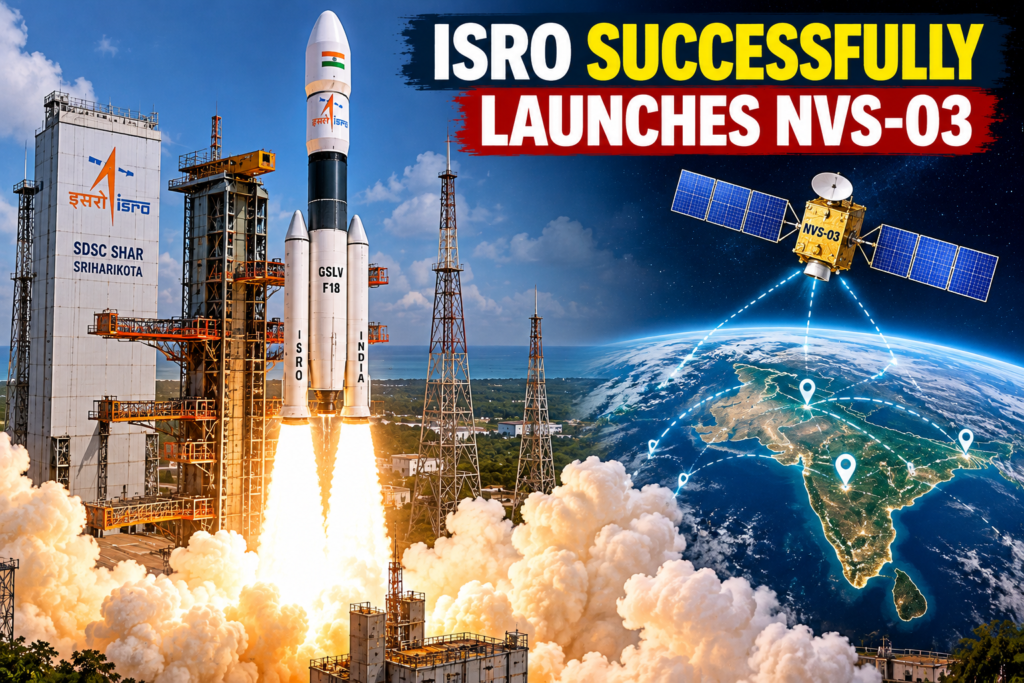

Sriharikota, October 31: The Indian Space Research Organisation (ISRO) has successfully launched its next-generation navigation satellite, NVS-03, aboard the GSLV-F18 rocket, marking another important milestone in India’s space programme.
The rocket lifted off at 11:51 PM on Friday, October 30, from the Second Launch Pad at the Satish Dhawan Space Centre in Sriharikota, Andhra Pradesh. The satellite was successfully placed into its intended Geosynchronous Transfer Orbit (GTO).
The mission marks the 20th flight of India’s Geosynchronous Satellite Launch Vehicle (GSLV) and is expected to strengthen the country’s independent satellite navigation capabilities.
GSLV-F18 Successfully Places NVS-03 into Orbit
The GSLV-F18 rocket carried the approximately 2.25-tonne NVS-03 satellite into space. Following its successful launch, the satellite separated from the launch vehicle and entered its designated transfer orbit.
The achievement represents another step forward for India’s efforts to develop and maintain its own satellite-based navigation infrastructure.
ISRO’s mission was designed to ensure continuity and improve the availability of navigation services under the country’s indigenous Navigation with Indian Constellation (NavIC) system.
What Makes the NVS-03 Satellite Important?
NVS-03 is the third satellite in ISRO’s next-generation navigation satellite series. It has been developed to support the existing Indian Regional Navigation Satellite System, which is operationally known as NavIC.
One of the important features of NVS-03 is its indigenous atomic clock, which supports precise timekeeping for satellite navigation.
The satellite also introduces the L1 frequency signal alongside the existing L5 and S-band signals. This addition is expected to improve compatibility with navigation receivers and expand the potential applications of NavIC, particularly for civilian users.
How NVS-03 Will Strengthen India’s NavIC System
NavIC is India’s independent regional satellite navigation system. It provides Position, Navigation and Timing (PNT) services across the Indian mainland and an area extending approximately 1,500 kilometres beyond the country’s boundaries.
The system supports several applications, including:
- Road and vehicle navigation.
- Maritime navigation and tracking.
- Emergency and disaster management.
- Precise timing and location-based services.
- Strategic and security-related applications.
The successful launch of NVS-03 is significant because NavIC has faced a shortage of operational satellites needed to provide standalone positioning services.
The addition of the new satellite, after it is commissioned, is expected to improve the availability and continuity of India’s navigation services.
GSLV’s 20th Flight Marks Another ISRO Milestone
The NVS-03 mission also marks the 20th flight of India’s Geosynchronous Satellite Launch Vehicle.
The GSLV programme has played an important role in launching communication, meteorological and navigation satellites into space. Its latest mission demonstrates India’s continued efforts to strengthen its indigenous launch and satellite technology capabilities.
The successful deployment of NVS-03 adds another achievement to ISRO’s ongoing work in space research and satellite-based services.
A Step Towards Greater Self-Reliance in Space Technology
With NVS-03 successfully placed in orbit, India has taken another step towards strengthening its independent navigation infrastructure.
The mission is expected to support the long-term development of NavIC and reduce dependence on foreign satellite navigation systems for applications where India’s regional system can be used.
The successful launch highlights ISRO’s continued contribution to India’s space programme and its efforts to develop advanced technologies for civilian, scientific and strategic purposes.