
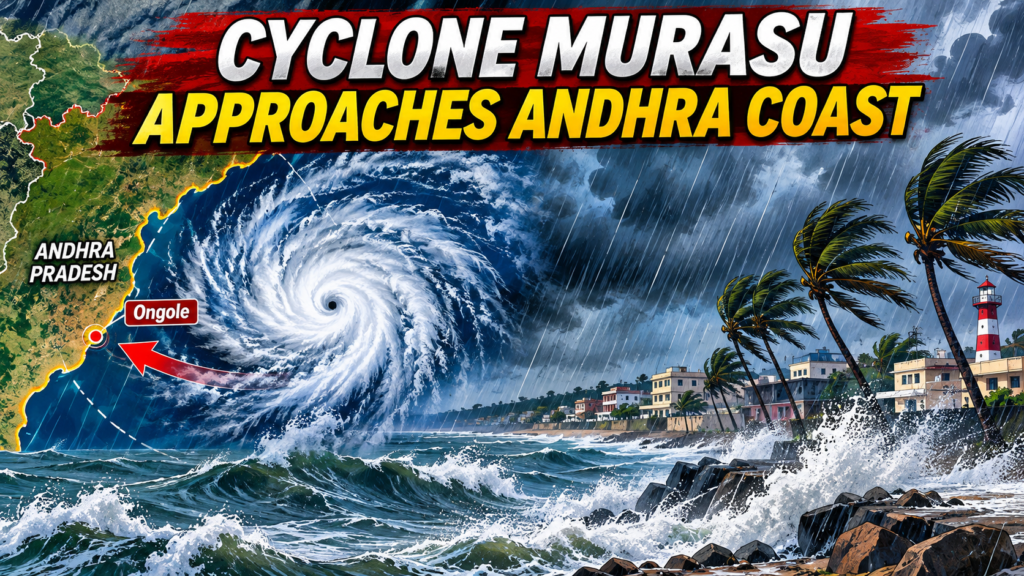

The Bay of Bengal is witnessing another powerful weather system as Cyclone Murasu has intensified into a severe cyclonic storm, prompting heightened preparedness along the south Andhra Pradesh coast. According to the India Meteorological Department (IMD), the storm is moving northwestwards and is expected to make landfall between Nellore and Narsapur, close to Ongole, between late November 2 and the early hours of November 3.
The latest development has raised concerns across coastal areas, particularly as the region is still recovering from the impact of Cyclone Arnab. The approaching storm is expected to bring strong winds, heavy rainfall and challenging sea conditions.
Cyclone Murasu Strengthens Over the Bay of Bengal
According to the IMD’s November 2 bulletin, Cyclone Murasu intensified into a severe cyclonic storm over the west-central and adjoining southwest Bay of Bengal.
The weather system was moving northwestwards at approximately 20 kmph during the six hours preceding the 2:30 AM observation on November 2.
At that time, the cyclone was located approximately:
- 260 km east-northeast of Chennai.
- 290 km east-southeast of Nellore.
- 320 km south-southeast of Machilipatnam.
- 310 km east-southeast of Kavali.
- 330 km southeast of Ongole.
The storm is expected to continue moving northwestwards towards the Andhra Pradesh coastline.
Cyclone Murasu Landfall Expected Near Ongole
The IMD has forecast that Cyclone Murasu will cross the south Andhra Pradesh coast between Nellore and Narsapur, close to Ongole.
The expected landfall window is between 11:30 PM on November 2 and 4 AM on November 3, 2026.
At the time of crossing, the severe cyclonic storm is likely to produce sustained wind speeds of 100–110 kmph, with gusts reaching up to 120 kmph.
These conditions could create difficulties for coastal communities, particularly in low-lying areas exposed to strong winds, heavy rainfall and possible coastal inundation.
Heavy Rainfall and Strong Winds Raise Concerns
Apart from powerful winds, heavy to extremely heavy rainfall is expected in parts of coastal Andhra Pradesh. The weather system could also affect neighbouring regions, including Tamil Nadu, Telangana and Odisha.
The IMD has warned of a possible storm surge of around one metre above the astronomical tide along vulnerable sections of the south Andhra Pradesh coast. Low-lying areas in Bapatla, Krishna and Prakasam districts could face inundation risks.
Sea conditions are also expected to remain high to very high along the Andhra Pradesh coast. Fishermen have been advised not to venture into the sea until the afternoon of November 4.
Coastal Districts on Alert as Cyclone Approaches
The approaching cyclone has increased the need for precautionary measures across vulnerable coastal districts. Strong winds, intense rainfall and rising sea levels could affect transportation, fishing activities and normal life in the coastal belt.
The situation is particularly concerning because Andhra Pradesh recently experienced the effects of Cyclone Arnab. The arrival of another severe weather system within a short period presents additional challenges for disaster preparedness and recovery.
Residents in potentially affected areas should follow official weather bulletins and instructions issued by local authorities. People living in vulnerable coastal and low-lying locations should remain alert and avoid unnecessary movement during severe weather conditions.
As Cyclone Murasu continues its northwestward movement, the next few hours will be crucial for south Andhra Pradesh. With landfall forecast near Ongole, authorities and coastal communities are closely monitoring the storm’s progress and preparing for its possible impact.
Cyclone Murasu is expected to cross the south Andhra Pradesh coast between November 2 and November 3, bringing strong winds, heavy rainfall and possible coastal flooding.