
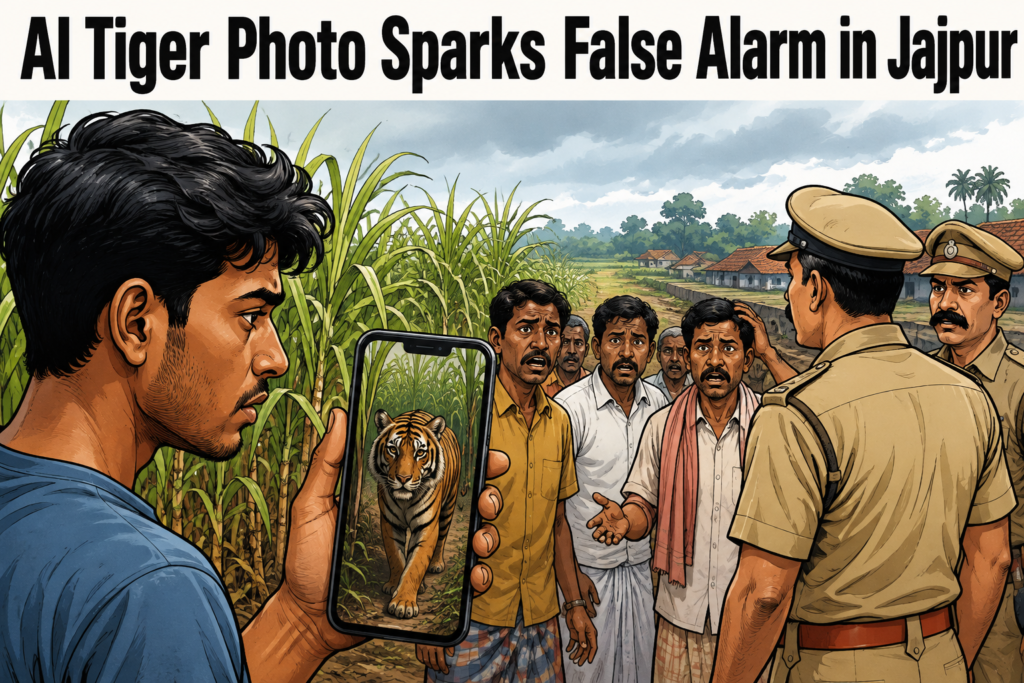

A youth has been arrested in Odisha’s Jajpur district after an AI-generated tiger photo was allegedly shared on social media with a claim that a tiger was roaming in a sugarcane field near a village.
The incident was reported from Talua village under Saudia Gram Panchayat in Barchana block, where the social media post reportedly created concern by claiming that a tiger was moving around the area.
The arrested youth has been identified as Srikant Kumar Dinda.
AI-generated tiger image shared as real
According to the information available about the incident, Srikant allegedly posted an image on social media and claimed that a tiger was roaming around Talua village.
The image was reportedly generated using artificial intelligence rather than being an actual photograph of a tiger spotted in the area.
The incident has drawn attention to a growing problem on social media: digitally created images can look convincing enough to be mistaken for genuine photographs, particularly when they are shared alongside claims about events happening in a local area.
Social media claims can spread quickly
A claim about a wild animal being spotted near a populated area can quickly attract attention, especially in villages where residents may be concerned about their safety, livestock and agricultural fields.
When such information is shared without verification, however, it can create unnecessary fear and confusion.
The Jajpur incident is a reminder that users should examine the source of an image and verify the information before forwarding or reposting it.
Why AI-generated images need careful verification
Artificial intelligence tools can now produce highly realistic images of people, animals, locations and events. Without context or verification, viewers may find it difficult to distinguish an AI-generated image from an actual photograph.
This makes responsible sharing increasingly important. A social media post should not automatically be treated as evidence simply because it contains a realistic-looking image.
In cases involving public safety, wildlife sightings or emergencies, information should ideally be confirmed through reliable local sources before being circulated further.
A warning for social media users
The Jajpur case also highlights the importance of digital responsibility. A misleading post can reach a large audience within a short time, while correcting the information may take considerably longer.
Users can reduce the spread of misinformation by checking when and where an image was taken, looking for confirmation from credible sources and avoiding posts that make serious claims without evidence.
The Jajpur AI-generated tiger photo incident shows why caution is particularly important when AI-generated content is presented as real-world information.
The case also serves as a reminder that technology can be useful for creativity and communication, but its output must be treated carefully when it is presented as factual information.