
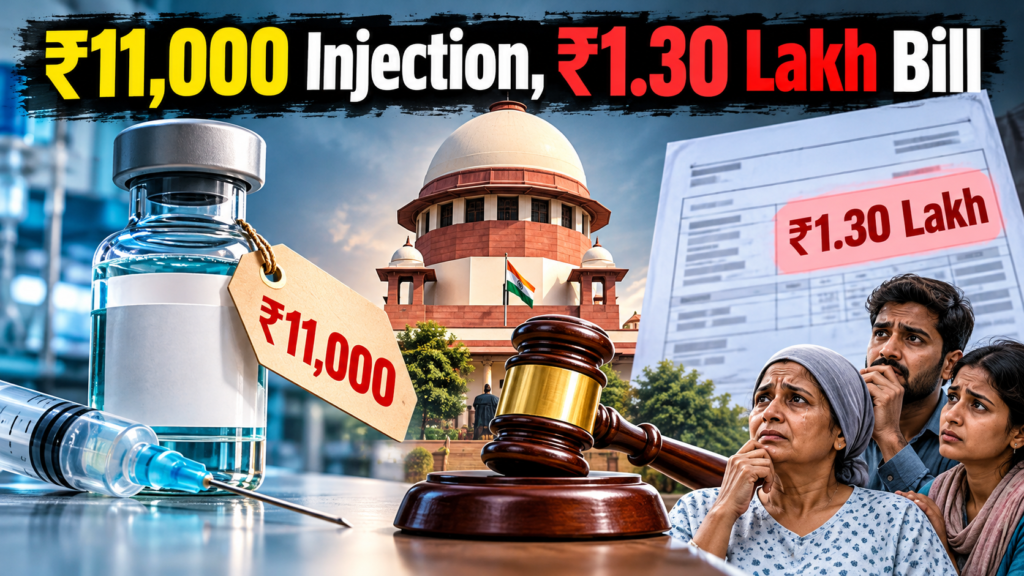

New Delhi, October 29, 2026: The Supreme Court of India has raised serious questions about medicine pricing after hearing that a private hospital charged ₹1.30 lakh for a cancer injection that a medical distributor said he could procure for ₹11,000. The incident has brought renewed attention to the cost of cancer treatment and the effectiveness of India’s existing drug price control system.
During a hearing on October 27, the bench of Justices Vikram Nath and Sandeep Mehta questioned the Centre over the substantial difference between medicine procurement prices and the amounts patients are asked to pay. The court reserved its order on petitions seeking stronger regulation of medicine prices and limits on excessive trade margins.
Supreme Court Questions the Cancer Injection Price Difference
The example discussed during the hearing involved a medical distributor whose wife was receiving cancer treatment at a private hospital. According to the account presented before the court, the distributor offered to obtain a chemotherapy injection at his dealer price of ₹11,000, but the hospital reportedly declined to administer the medicine he supplied and charged ₹1.30 lakh for the injection.
The judges questioned how such a large difference could be justified, particularly when patients undergoing serious treatment have limited opportunities to negotiate prices.
The bench also raised concerns about the pricing of other medical supplies, including saline drip lines, highlighting the wider issue of the costs patients face during hospital treatment.
The observations reflect the court’s concern over affordability and transparency. However, they do not themselves establish that every hospital’s medicine pricing is excessive or introduce a new price control rule.
Why Medicine Pricing Is Under Scrutiny
India’s drug pricing framework operates under the Drugs (Prices Control) Order, 2013. The National Pharmaceutical Pricing Authority (NPPA), which functions under the Department of Pharmaceuticals, regulates the prices of scheduled medicines by fixing ceiling prices.
Medicines outside the scheduled category generally have greater pricing flexibility. Manufacturers can set their initial maximum retail prices, although annual price increases are subject to restrictions under the existing framework.
This distinction has become central to the legal challenge, which seeks stronger controls over non-scheduled medicines, mandatory generic prescriptions and limits on trade margins for medical devices.
The petition before the Supreme Court was filed by advocate Kishan Chand Jain. It raises questions about whether existing regulations provide sufficient protection against large differences between the prices at which medicines enter the supply chain and the final charges imposed on patients.
Centre’s Position and Hospitals’ Arguments
During the hearing, the Centre defended its approach to medicine pricing, arguing that the government’s policy seeks to balance affordability with competition, innovation and the growth of the pharmaceutical industry.
Representing private hospitals, senior advocate Mukul Rohatgi argued that healthcare institutions must cover the costs of infrastructure, equipment, staffing and round-the-clock services. He also raised concerns about patients bringing medicines purchased from outside pharmacies, including questions about the authenticity and quality of the products.
The bench questioned whether these operational requirements could justify the substantial mark-ups described during the proceedings. The discussion highlighted the challenge of balancing hospital operating costs with patients’ need for affordable medicines.
The court has not yet delivered its final decision on the petitions.
Government Moves to Reduce Cancer Medicine Costs
Separately, the government has announced measures to address excessive trade margins on selected cancer medicines.
On October 17, 2026, the Department of Pharmaceuticals announced trade margin rationalisation for 137 identified non-scheduled anti-cancer drugs. According to the government’s announcement, the intervention is expected to reduce the maximum retail prices of the identified medicines by up to 70%, depending on their existing price structures.
The revised prices are scheduled to take effect on November 9, 2026. Manufacturers are required to notify the NPPA of revised prices, while retailers and hospitals must implement the applicable reductions and display updated prices.
The government has also directed that patients and healthcare providers should be able to access information about revised medicine prices through official channels, including the NPPA website and the Pharma Sahi Daam app.
The measure covers the identified medicines and should not be interpreted as a universal price reduction for every cancer drug or every component of hospital treatment.
What the Case Means for Patients
The Supreme Court’s intervention has placed medicine affordability and hospital billing practices at the centre of a wider public health debate. For families paying for cancer treatment, the difference between a medicine’s procurement price and its final billed amount can have serious financial consequences.
The outcome of the petitions could influence future discussions about drug pricing, generic prescriptions and the regulation of trade margins. Until the court issues its order, however, the existing rules remain applicable alongside the government’s announced pricing measures.
The central question remains whether India’s drug pricing framework can provide stronger protection against excessive charges while ensuring that hospitals and medicine suppliers can maintain reliable access to essential treatments. The Supreme Court’s examination of Supreme Court cancer drug pricing is therefore an important development in the continuing debate over affordable cancer care in India.